Friday, 3 June 2011

Keeping back the sea

So Wednesday we were up in Drenthe, the northeast part of the country. Yesterday we went to the opposite end, the far south west where the North Sea meets Belgium, to Zeeland see how the Dutch control the sea. Down there, it all started with the great flood of 1953.


A massive storm in the North Sea in January 1953, combined with a pretty high tide, put the water 18' above mean sea level. While a bunch of the land near the sea is in fact above sea level, the whole place is protected by various dykes, that (just like New Orleans a few years ago) breached with the storm. They estimated that flooding killed 1,835 people and forced the emergency evacuation of 70,000 more. Floods covered 9% of Dutch farmland, and sea water inundated 1,365 km² (527 square miles, 337,000 acres) of land. An estimated 30,000 animals drowned, and 47,300 buildings were damaged of which 10,000 were destroyed. Obviously, this pissed off the Dutch, and they said it would never happen again. Enter the Delta Project.


The plan was to basically dam it up so it couldn't happen again, but environmentally, this was problematic, because it meant closing off huge estuaries that were the home to fertile fishing and mussel grounds. So the ever practical Dutch built a series of storm surge dams that are open unless they need to protect the place. Itty bitty little 9 km long structures, like the Oosterscheldekering (Eastern Scheldt storm surge barrier).
Part 1 of 4 protecting this section of the estuary
See the arc of white in the distance? Part 2 of 4
This is open to the sea (on the left in the above photo), and the tide just whooshes through when it's coming in, like it was when we were there.
Water in a hurry
You get to crawl through the innards of this structure, getting literally inside the bridge, getting up close and personal with the hydraulics, the massive gates and the story of how it was built.


The top of the innards
Hydraulics controlling the gates
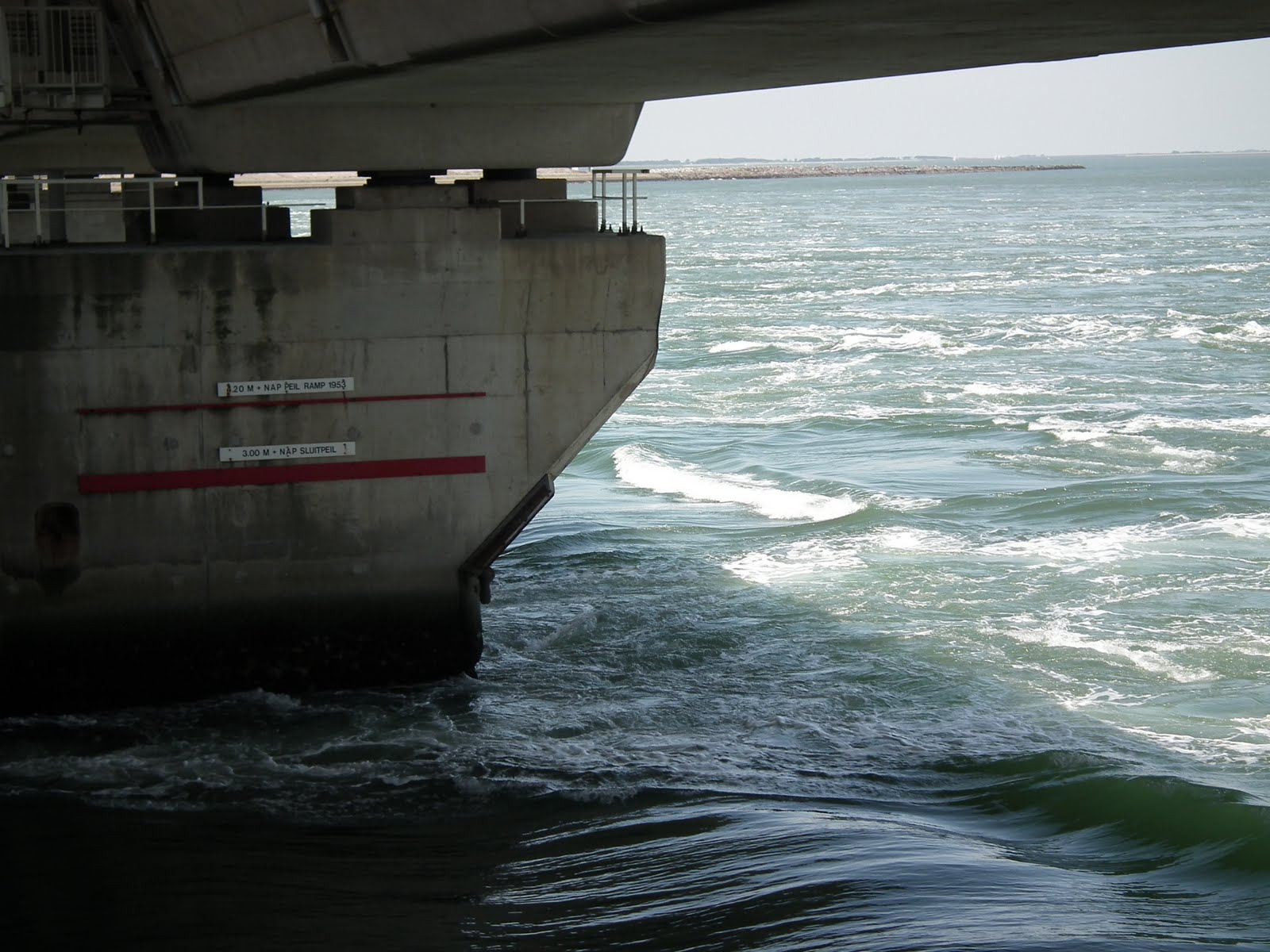
Just to show you what they are up against, the bottom red line in the photo below is 3 m above mean sea level, the point at which they close the gates because the water is too high. The top line was the 4.2 m mark of the 1953 flood. The thing has been closed 24 times since opening in 1985.

That's a lot of water
So the dam itself was cool. However, getting there was not "half the fun". The access to the dam (and the museum about it, including movies of the 1953 flood) is inside something called the Deltapark Neeltje Jans, which is a really lousy and cheesy "theme park" complete with kids waterpark, seal and sea lion shows, 3D Hurricane Experiences and bad rides -- which costs €21 per person to go in.


Worse, it turns out that Thursday June 2nd was Ascension Day, a holiday in Holland, or at least this part of it (which we only learned about mid-day). So instead of running every half hour, busses to and from this place were running every 2 hours. This made visiting the dam a very time limited proposition, so it was a bit of a challenge.


The dam is closest to the town of Middelburg, which would probably would be a nice town to visit were it not for the fact that on Ascension Day, everything is closed, and the streets look like morgues.
The main shopping street at 11 AM
But the town has nice building, including the Stadhuis...
I'm not an architect, but this is one interesting mix of styles
...an Abby, first started in AD 885 (but added to several times since)...
Towers and chapels
Inside the courtyard. More steeples
The shady part of the courtyard
...and other old buildings.
Circa 1532
Circa 1735
It's also a moated town, with nifty medieval fortifications, and and 2 windmills to boot.
The original bridge is sadly gone
An idyllic scene
Built in 1732
And the main reason we went there Thursday is that it is home to a really good market.
Smoked mackerel
Nectarines
This guy sold nothing but local strawberries with lots of locals buying them
Boxers, 5 for €10
Books on the left, clothes on the right
This guy sold nothing except remote controlled helicopters
...all in the shadows of the Stadhuis.
Ah, THAT'S where the crowd is
I think in the end it should have been obvious it was a national holiday. Amsterdam Centraal station was EMPTY at 7:15 AM, the train was empty despite stopping everywhere (including peoples houses, I think, when we got to Zeeland proper), and on the bus from Middelburg to the dam, we saw thousands of people on the bike paths, windsurfing, kiteboarding, on the beach, driving campers -- the Dutch on vacation for a 4 day weekend.


Visiting the dam was a kick, and I'm glad we did it. But Middlelburg is 2½ hours away by a "stop everywhere" train, and the dam a half hour past that. Maybe not the best daytrip we could have picked.

Diamonds and beer

A few days ago (I'm losing track of time), after visiting the incredible flower auction house, we caught two tourist traps in town. One was free, and for that reasons was OK. One cost €15 per person and was a rip off, but man, the tourists seem to like it.


Our first was to watch guys turn these...
Two raw diamonds
...into this...
1.64 carat, near perfect colour, 121 facets. Only €24,850. Get two, I say.
...like this.
Grinding in the facets 
Checking... 
...and more checking.
The "tour" here is more like an extended sales pitch for Gassan. But you get to talk to the guys polishing the diamonds, which made it worthwhile. Here's some of this thing I learned:

  • It takes like 4 days to add 64 more facets to a brilliant cut diamond that already has 57 facets.
  • There's no "school" to learn diamond cutting and polishing; it's all on the job.
  • You can turn any diamond, of any size no matter how small, into any kind of cut you want, but there's no money in it to work the little guys, because it's too labour intensive.
  • It's like an assembly line, because the folks who do it get specialized (and mistakes are somewhat costly). There are people who just cut rough diamonds into rough "point" shapes using saws. There are folks that just chop them in half to create a basic table cut shape. There are folks that just add facets, and other folks who just add more facets.
  • By the time you're done, the stone is at least 50% smaller than what they started with, and the rest is ground into dust -- and the dust is kept to make tools that cut diamonds and other things.

KC saw many, many sparkly things she liked. Fortunately for me, there were sufficient restraining harnesses to prevent her from emptying my retirement savings.


From Gassan Diamonds, we wandered across town, passing a drawbridge being raised that had tram tracks on it...
Note the slots that open in the road for the overhead wires
...which created a traffic jam of about 50 bicyclists and 20 pedestrians on each side...
Backed up, waiting impatiently
...and an interesting piece of art.
Fallen tree, complete with stump, all made out of metal
Then we went to the Heineken Experience, in the building that was the original Heineken brewery. I've toured a brewery or two in my time, and have made my own beer. While it is always interesting to see the original copper kettles (now worth millions for the copper alone)...
Beautiful copper 
Engineering meets art
...this "tour" is a huge ripoff, full of misinformation (Heinekin is not the only top fermented commercial beer; hops do add bitterness but not only in the head, and they are used to flavour beer, too; the amount of oxidation that can occur in the glass is meaningless and the head doesn't stop it anyway) and really a waste of time, unless you really like watching historical Heineken commercials...
Numbed by the radiation
...or want to make a silly video...
...or get your photo taken.
We got this taken because?
It costs €15 per person to get in, and you get 3 beer (which considering you can buy a 250 ml Heinekin in the store for about €1.20 or in a bar for about €3.00, seems a might bit steep to me).


Ordinarily, diamonds and beer would make a great combo, but today less so. At least the sunset that night was nice.
Colours out the window.

Wednesday, 1 June 2011

Exploring the forests and history of Drenthe

The weather has once again turned nice, and that means getting out and about. Today, we ran up to the Drenthe province, around Assen and Borger, just south of Groningen, to go look at some ancient Dutch history.


The majority of the Netherlands is flat as a pancake, as it is primarily the delta of the Rhine. However, contributing to the flatness was the ice age glaciation of some 180,000 years ago. Just like at home, this left some rocks (more precisely, glacial erratics) scattered around. But you never see rocks here.


About 4,000 BC, and for about 2,000 years, the area was populated by stone age tribes. Over their time there, they were moving from being hunting/gatherers to existing as stationary farmers. They didn't leave much behind, but they did leave megaliths. A great example of a megalith is Stonehenge. A megalith is a really big thing built out of really big stones.


The folks here built something the locals call "hunnebeden." What they were isn't really clear; they could have been houses, but they were probably burial tombs. What they really are is amazing, because they are made of 20,000 pound glacial erratic rocks carefully balanced on one another.
Note KC crouching to take a picture
Okay, so first question: How'd they do that? The engineer in me says rollers made of wood and levers, but that seems around 3,700 years before Archimedes claimed to have come up with that lever idea.


And there is not just one of these things, but 54 of them (explaining why all the rocks are gone), and we got to see about 12 of them while bicycling around the area.
Trusty rent-a-steed
Some are small and cave like and sitting on the top of a mound.
Only a small shelter now
Some are big, and have massive rocks that look like elephants and whales...
See the "elephant rock"? Me neither until someone pointed it out
...if you believe Gandalf the Red, who was handing out free info on them.
A very nice, very helpful, but strange old codger
Some come in bunches...
This is 2 of 5 in the grouping 
A pair
Some rocks are precariously balanced.
Remember, the top one weights several tons
They found pottery and stone tools inside some.
Stone axe heads 
Reassembled pottery from the "Funnel Beaker Culture"
So they are kinda cool, and we enjoyed seeing them. But just as much, we enjoyed riding around the countryside, which is really nice up there. The forests are dense and littered with paved bike paths and walking paths in the woods.
Straight, smooth, flat and paved
A hiking/riding trail. Arrow straight, like many
There are little lakes periodically, full of croaking frogs and the odd duck or two.
A very peaceful little lake just off the highway
The boys are chasing the girl (as always)
And it smelled just wonderful in the forests, in fact just like the mountains where I live. Okay, so mostly the forest is a re-forest, with the trees in rather neat rows, and there's evidence of logging here or there. But it was full of birds and just really pleasant riding. It would be a great area to explore more.


Tomorrow: Middelburg and the dams that keep the sea out of the land.