Wednesday, 15 June 2011

2011 Canadian Grand Prix

After 7 years of fabulous race weather, this year was somewhat less than fabulous. I have always said rain races are my favourites, but I never wanted to attend one. This year, we did. It started raining an hour before the race, the race started on a sopping wet track in the rain behind the Safety Car, then after about 15 laps they stopped it for 2 hours as the rain got harder and harder -- and we loyal fans just stood in the rain the whole time. The race re-started when the rain stopped, but an hour after the race was over, the monsoon started again. By the end of the day, all 150,000 people at the track were wet as drowned rats.


In the past, I have split these posts up, but this year I whittled my 350 pictures worth keeping into 35 worth sharing that cover the whole weekend. I will put them in order, and keep commentary to a minimum, generally with photo captions only.


First, Friday practice, which is the best place to get "up close & personal" photos. In posting the best photos, I'm not covering all the drivers. Since Michael Schumacher turned a lot of laps on Friday, I got a bunch of shots of him.


Michael Schumacher 
Jerome d'Ambrosio 
Mr. Schumacher again 
Sebastien Buemi
Mr. Buimi, a little closer
Nico Rosberg

Mr. Schumacher photo #3, being chased
Lewis Hamilton chasing Mr. d'Ambrosio 
Vitaly Petrov chasing Kamui Kobyashi
One of the support races is a historical GP race. This is the 1980 Williams once driven by Alan Jones.
Pretty, and pretty historical 
My guy Jarno Trulli
 One of the features of my camera is a multiple exposure mode. I don't have much use for it except here.
Someone from Force India chasing someone from Marussia Virgin 
Reubens Barichello, in his 319th GP 
Mr. Schumacher. Photos of him are getting repetitive 
Lewis Hamilton 
Narain Karthikeyan 
I find it interesting that there are two Lotus teams, both using the same Lotus insignia.
  • One, that Jarno Trulli drives for, is called Team Lotus. Their car colour is British Racing Green. They are powered by Renault engines. The drivers wear green.
  • The second team is called Lotus Renault. Their car colour is black (after the classic JPS Lotus' of the 1970's and 1980's) but their mechanics wear green. Their logoowear that you can buy calls them "Classic Team Lotus"
Two different Lotus teams leave the pits 
Mark Webber leads a mass pit exit 
To Saturday. The time on the track is less interesting because the drivers have figured the track out and spin out less, plus it's qualifying, and they want to have good clean runs. So we spend more time in our grandstands, and watch a few support races.
Typically crowded Saturday in Grandstand 12
Mr. Webber 
Pastor Maldonado. He didn't have a good race (see below) 
Mass start of the Formula 1600 race, with drivers as young as 15 
Flat spotting the tires
Sunday was monsoon day.
The start behind the pace car 
Why even when going slow, you want to be first 
The pace car leaves. Vettel and Alonso fight for the first corner 
Mr. Hamilton whacks Mr. Webber on the first lap 
Mr. Maldonado on intermediate rain tires 
Paul Di Resta chases Sebastien Buemi 
Weber chases Schumacher as Kobayashi comes out of the pits 
Mr. di Resta spins out, and sits pointing the wrong way, in the way 
Mr. Maldonado hits the wall exiting the pit on cold tires
To this moment, I don't know how Jensen Button managed to be dead f#*&@ing last on lap 30, pit 6 times, get a drive through penalty and still win the race. But he did. The best part of the race was the "who's in 3rd?" three way battle between Webber, Schumacher and Button that went on for about 10 laps.


After the race, we did not run to the podium as we did last year. But we did get to the pit wall to see the cars, up close and personal.
Up close to the Ferrari of Felipe Massa 
A mass of cars at race end scruitineering
We hung out on the track for about an hour then the heavens opened again. We then had to wade through 3" deep rivers of water to find a place to hide from the rain.


There's a great line at the end of Four Weddings and a Funeral, by Carrie standing in the rain:
There comes a point where you can't get any wetter
We were well past that point at least twice on Sunday. As I write this, 3 full days later, my wallet is still wet, as is the inside of my daypack.


But the race was fun.

Tuesday, 14 June 2011

Escher and the way home from Europe

I mentioned that there was an Escher in Schiphol airport, and there is. But you're not supposed to be able to see it. It's in Lounge 4, which although inside the building, is separated from the rest of the airport by glass walls or mesh. I gather from asking a few people it's because it's easyJet's lounge, and no one seems to like them. Or maybe there's some other reason.


Anyway, if you take the elevator to the 2nd floor, and go WAY to the end, you can see Metamorphosis III. Like the most of Escher's work, it's a print. But this is series of 33 woodcut prints printed onto 6 separate sheets of paper which were then painted by hand. And it's a whopping 48' long.
Really, really big
Detail 1: hand painted ships, birds and fish

Detail 2: Salamanders, of course
It's a real shame it's not in the main part of the airport.


The flight home was uneventful but mostly cloudy, except for parts of Greenland.
Mountains in a sea of ice 
Excellent glacial features 
Fjords. Saw icebergs but didn't get any pictures

Ridin' in the rain to the dunes and bunkers

Only 30 minutes from the Amsterdam Centraal station by hydrofoil ferry...
A screamin' 35 kts
...is the town of IJmuiden, which lies at the entrance to the Noordzee canal, the main shipping channel from the North Sea to Amsterdam. No, I don't know why the I and the J in IJmuiden are capitalized. There's an IJ river, and several other IJ places, too (perhaps Edwin can explain...). While I do find sea ports and monster mega-locks mildly interesting, we went there to visit the Nationaal Park Zuid-Kennemerland. This is a 10 km or so strip of sand dunes that are more or less in their original state.


Now, these are not Oregon "multiple square kilometers of moving sand dunes 150' high" (which I love visiting and going dune jumping on, as my daughter can attest). These dunes are classic depositional dunes that one finds at river mouths. They start with a long sand beach...
A long beach 
In both directions. Note the sand "hills" on the left
...and a linear sand foredune just behind the beach, which is the hill in the above photo. The foredune is held in place by grasses and tends to become fairly stable. Behind this in the swales you get freshwater (or in this case, brackish water) ponds that are linear (thought the park didn't have very many of these).  If the river has been around a long time (like, say, the Rhine), over time, the depositional process repeats, and you build plains of several rows of linear relic foredunes, and that's where the park is and the environment it supposedly protects.
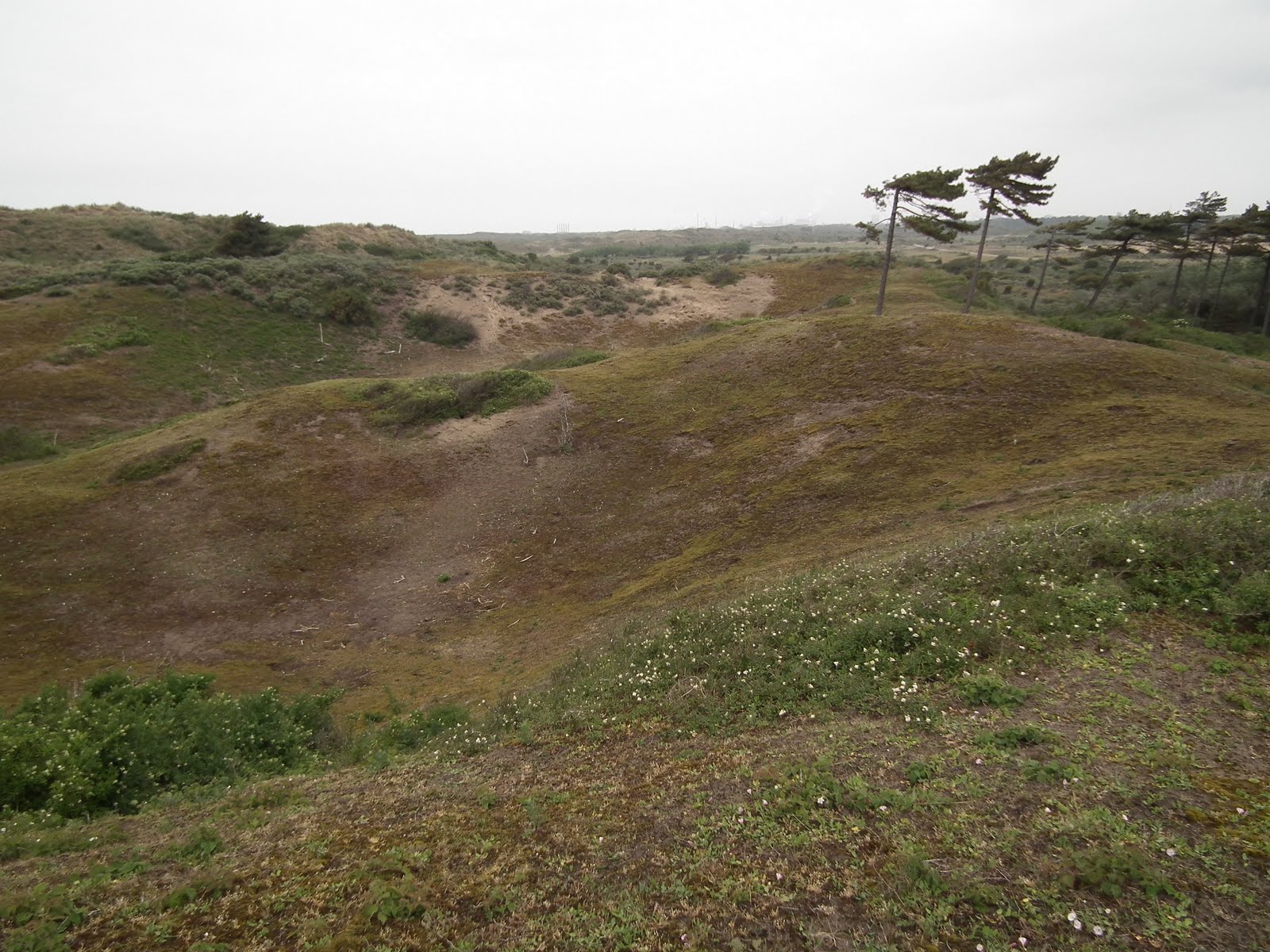
On the top of a relict foredune, some 2 km inland. Ocean in the distance.
Sometimes, the wind scours the grasses off, and you get sand movement, typically parabolic in shape and in the direction of the wind. You can see the wind affected trees in the above photo, so you know it's normally windy here. But there were only two large-ish sand fields contained within the park, and neither is more than a square kilometer in size.
Scouring in the grasses 
This sand field is actually stabilizing
In motion
Also in motion, but the grasses are winning 
Classic aeolian (wind driven) patterns
There are a couple of freshwater lakes in the bigger swales.
Large lake in a larger swale from a relic foredune 3 km inland
This is an interesting national park, though not too "natural". They let cows (Highland cattle) run free in here, and they are very big and have big horns.
Big boy. Or girl. With eye level pointy bits
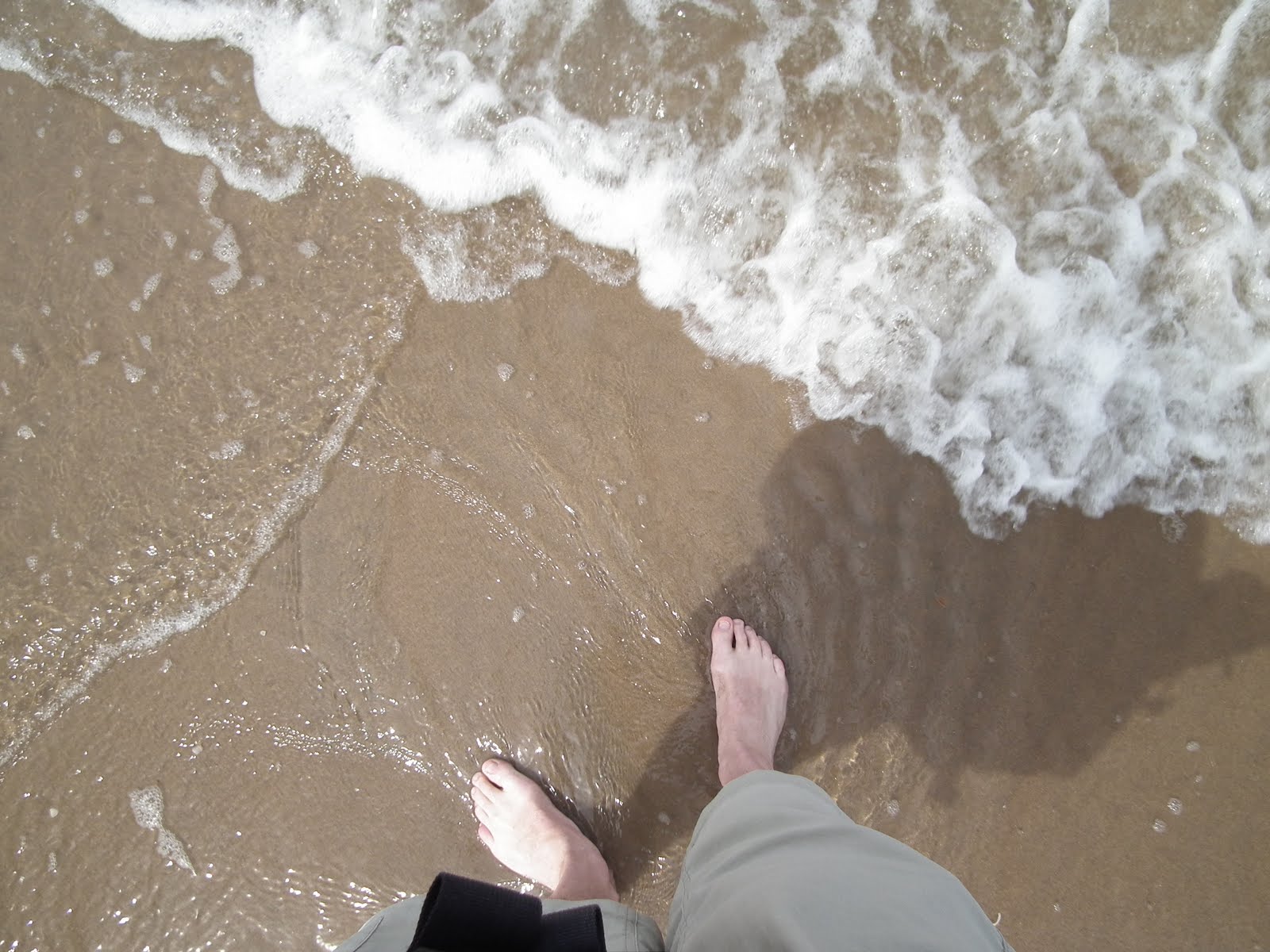
There are numerous farms and residences inside the park, since the park was only established in 1995. There's even an area where European bison roam free.  And it was a good place to dip my feet in the North Sea.
Cold.
So geologically, it's an interesting park, and it was an interesting place to ride to. However, 90 minutes into our ride, some 14 km from the start and almost at our turn around point, it started to rain. Fortunately, we were near a beach restaurant, so we sat on their covered porch for an hour, picnicking, staying warm (it was only 14°) and dry while it poured. (Note to Formula 1 race fans: Where we stopped was only 2 km north of Zandvoort, the site of the Dutch Grand Prix races held from 1955 to 1985).


Since we had stopped and explored most of the geology, as well as rode most of the way through the park on the way to lunch, we had some time to spare in the afternoon, so rode into IJmuiden's port area, and ran across a group of WW2 German bunkers embedded in the 2nd line of foredunes and a bunker museum (sadly not open).
Interesting rearward facing machine gun pillbox 
KC peers into a sand filled gun emplacement and tunnel access 
Trusty steeds in front of a major bunker access point 
Rows of 2 story big gun bunkers
Crawling around these was interesting, though I was not impressed that graffiti goons seem to think historic sites are good places to deface. Near as I could understand from the interpretive signs, Hitler was convinced the Allies were going to invade the continent somewhere in the Netherlands, and so had monstrous defenses and multiple rows of bunkers built to guard the port.


It was a very nice day trip, and pretty riding. The park has a ton of birds (the downside to biking is the difficulty in stopping to birdwatch). We did about 36 km on heavy 3 speed Amsterdam bikes; it would have been easier with nicer bikes, but you have to rent bikes in Amsterdam and bring them with you, and most places in Amsterdam rent pretty heavy duty bikes by the day.

Monday, 6 June 2011

On our way home

We went to IJmuiden and went bike riding in one of the National Parks in the rain today, but that story will have to wait for another day, as it is time to pack up. Our month in Amsterdam and Holland is over tomorrow, and we head out to Schiphol airport early. I have several summary posts yet to do, in particular of picnickers on the canal edge. I'm glad we're not doing anything but catching a train tomorrow, as there is a one day transit strike on which will shut down the busses and trams.


I'm off to Montreal on Thursday for the Canadian Grand Prix, so don't know how much will get posted in the near term. But stay tuned, loyal readers, as there is more Holland to come.

Sunday, 5 June 2011

No attacking this place

The town of Naarden, about 30 min east of Amsterdam by train, isn't a very big town, about 800 m by 1,000 m. But it has stood for centuries at a critical crossroads on the Amsterdam-Utrecht road, and served as a major part of the defense of Amsterdam. Unlike so many other towns that removed or built over their medieval defenses, Naarden preserved them, and now the entire town is virtually a museum, as you can clearly see in this satellite image of town from Google Earth...
Double moated and heavily fortified.
...and it has the national fortification museum on one of the preserved defensive ramparts (the one at the 7:30 position in the above photo). This is a great museum, where you can see the history of fortification design, lots of old cannon, and read about the defense of Amsterdam.
Three cannon in this direction. Standing on top of the gunpowder store

Highly protected

Cannon from the 1800

Cannon on top of the bastion. 5 on the top
Each bastion had 14 cannon inside tunnels underground, plus 6 more above ground firing to the sides, plus 5 on the top firing to the front, and 3 mortar hiding in a trench firing to the front. That's a lot of firepower. The bastions themselves had underground bunkers and tunnels.
2 m thick walls
Under each 60 m long side of the point were listening tunnels...
Long and dark
...which were quiet and had holes in the roof leading to caps that enabled you to hear if anyone was trying to paddle across the canal.
Listening holes along the tunnel
We took a little boat around the moat with a really nice and knowledgeable guide who gave us a view and description of the outsides of the fortifications.
5 cannon pointed at you 
As the cannon got bigger, they had to move the holes up 
Guy on top of bastion. Very tall to get over
As I mentioned, Naarden did not get rid of any of its fortifications or its old buildings. They are now "something". Some are restaurants. Some are shops. Some are even houses.
1877 gate. Now tourist info office and gift shop 
1875 former barracks on a ravelin. Now an art gallery. 
Left to right: Beauty salon, clothing boutique x 2, office 
The arsenal. Now a "shopping centre" 
Killer bathroom boutique
If it were Calgary, we would have condemned them all, torn them down and built condos.


The rest of the town is very pretty, and really nice to walk around.
The one canal inside the walls 
The main drag 
The church in the centre of town 
Inside the church. Couldn't see more as there was a photo show on 
City hall. Built in the 1630's
Sidestreet 
A quiet garden
Naarden is an outstanding daytrip form Amsterdam, being just 30 min away by trains that run twice an hour (and cost about €4.50 one way). Don't make our mistake when visiting, however. We rented bikes at the Naarden-Bussum train station. This isn't necessary and is actually quite a hassle. Naarden is only about 6 min by bicycle from the station, and once in the town, a bike is a hinderance. You can walk the top of the ramparts but can't cycle them, as there's a lot of steep ups and downs, stairs and no paved paths. It takes only 10 min to walk from one side of the town to the other.


No, don't rent a bike if all your are going to do is vist Naarden. Walk the 20 min to town; it's easy to find. Turn left coming out of the station, and stay left paralleling the tracks on the bike route for about 10 min. Turn right at the end of the long straight canal like pool, cross the main road and bear right. In 5 min walk you will see the fortifications.


On the other hand, if you do rent a bike, get there early enough to ride the 6 or so km up to Muiden (near Weesp) and go see Muiderslot, a very cool moated castle I have seen in movies but did not have time to visit.


By the way, Naarden's fortifications were never tested. They were built as a result of the Spanish war in 1572 when the Spanish massacred all the adults in town. They kicked a lot of people out over the centuries but were never attacked. The fort was active until 1920 when it was made obsolete with munitions that could penetrate ground and then blow up. In WW2, Allied bombers used the rather distinctive fortification shape as a navigation aid.


Naarden was also one end of the Dutch Water Line. This was a series of defenses first built in the 1630's that could flood a whole lot of the country and make the important places effectively an island. The line proved its value less than forty years after its construction during the Franco-Dutch War of 1672 when it stopped the armies of Louis XIV from conquering the Dutch Republic. It was ready for use until finally being dismantled in 1963, and upgraded on 3 separate occasions, including just after Napoleon's defeat, and just after WW2.