Tuesday, 5 May 2015

April 30: To the Caves

It dawned gray, cool (14°) and raining. Fortunately, we have enough days here and enough things to do so that we could can our planned activity (hiking in Wilderness National Park) and instead, drive back into the desert to visit the Cango Caves. This we decided over breakfast at our hostel.

Dining area in the common space
On our way to the caves, we stopped at an overlook of the Wilderness beach that we wanted to stop at yesterday but didn’t because of time. Wilderness is a carbon copy of the Oregon Coast.

18 km of beach
That was at the Kaaimans River Pass.

All the passes are labeled
And this is the Kaaimans River.

Lots of sand from eroding sandstone cliffs
Apparently at this rest stop, it’s illegal to stack your cannonballs without putting an extra one on top. Or something like that.

Huh? What am I not supposed to do?
To get an idea about how big this beach is, look for the two dots in the photo below: people on the beach.

Wow. Humans.
While we were in the desert yesterday, we noted to someone it was raining on the coast. They said it always rained on the coast but never in the desert. Sure enough, as we went up the Outeniqua pass, it stopped raining at the top, and was sunny within 10 km. So we retraced our steps from yesterday for about 100 km, and went to the Cango Caves.

The "public" portion of the 4+ km of cave
I was impressed by the visitor’s centre, which has an amazing geology and natural history section, including replicas of the earliest human fossils ever found (australopithecus, Mrs Ples and others). 

We picnicked and then went into the Adventure Tour. The shorter tour shows a couple of the caves biggest rooms, but the adventure tour makes you do belly crawls, chimneys and slides.

Getting to the area, you don’t think there’s much limestone around. It’s all red conglomeratic rock. But the cave entrance is obviously limestone.

Precambrian limestone in the middle of sandstones
The formations in the first rooms are dried out and not active, but still very impressive.

50' tall 
Columns 75' tall 
Formations for scale
More columns
The “adventure” tour is different than the "historical tour". It’s 20° and 100% humidity, meaning every section where you have to work -- and there are a few -- leaves you dripping in sweat. Our tour guide seemed to be in a rush, so we spent little time focusing on the incredible helictites, flowstone, cave popcorn & curtains and other formations that were in the adventure section and still wet and growing.

Way in the depths, glistening and growing
I always think I’ll get good pictures of just how tight some cave features are. But in a cave, I’m too busy to take pictures. So here’re the only ones I got: KC making it down through the Letterbox Slot.

She didn't fit the right side 
Slipping out
There was a very slippery chimney we had to climb, and a narrow passage we had to slide through sideways – all the while making a mess of the cave features. Sigh. 

On our way home, we stopped for one last overlook of the “Oregon Coast”…

Misty
…and to see an overlook optimistically called the "Map of Africa".

To me, it looks like a river valley
Allegedly, that river valley causes the mountains on the other side to look like a map of Southern Africa. Stretches my imagination, but sure, if they say so.

We headed for town to dinner at The Girls, the most expensive restaurant we have eaten at so far this trip ($75). Really good seafood, which given the proximity to the Indian Ocean isn’t surprising.

=================

Today’s Travel Tip: Wildlife Dangers while Driving

So far (and only so far), I’ve seen road signs warning about tortises crossing, some kind of ungulate with spiral horns crossing, baboons crossing, and ostrich crossing, the same kind of signs I see at home about deer. I see big warning signs about not feeding baboons (that’s apparently pretty stupid; some baboons are learning to open car doors, which my grizzly bears never do). And I’ve already seen animals on the road, especially baboons, which travel in large troops.

Road hazards are just different here.

April 29: To the Garden Route through the desert

It was miserable and raining in Stellenbosch when we woke. I had deliberately selected a route that was not the fastest but would be beautiful, over mountain passes and off the beaten track. Alas, the viz in Stellenbosch was terrible, but we decided to soldier on, hoping it would be better across the mountain passes. The route I selected avoided the “fast” 5 hr route along the N2 and portions of the coastal route. Instead, we went via Routes 60 and 62, though the central desert. My logic was since we would come back via the fast route, we would take a scenic route there.

We were up early, and on the road out of Stellenbosch by 8:45 AM, half an hour later than we wanted. We got on the N1 near Paarl, and got off of it fairly quickly, opting not for the Huegenot Tunnel but the old Huegenot Pass over the mountains. It looked like the pass would have been spectacular, except that there was only 100’ visibility in rain, so it sucked. We saw our first wild animals on the route; a troop of ~20 baboons, which are really not that rare. In fact, we saw 5 troupes of baboons during the day.


The only short tunnel 
Oh, were it not raining 
Yes, that's a baboon 
The Misty Mountains
On the “other” side of the pass, we turned off the N1 onto R60 at Worcester, hearing for Robertson. This valley (the Breede) is a forgotten sister of the Stellenbosch/Paarl wine area, and is home to lots of vineyards and wineries (though also is the home of a lot of brandy, too, so the wine is generally thin and uninteresting, making it excellent for brandy). It was a pretty valley…


Dry and mountainous
…but still raining occasionally, so no great photos. The route we took passes Robertson and Ashton, and crosses a mountain pass…


Upthrusted sandstones
.. to Montagu, then runs on the back (dry) side of the mountains for 100 km…


No traffic and big mountains
…along the way passing Ceres (home of a lot of fantastic fruit juices) and Montagu, “the home of dried fruit”. At Barrydale, we gassed up and headed north across a lot of uninhabited wilderness where there were warning signs for the local 2-toed ungulates (at home, it would be deer. Here, it’s oryx, springbok, blesbok, antelope or duiker, but disappointingly we saw none, so no matter).

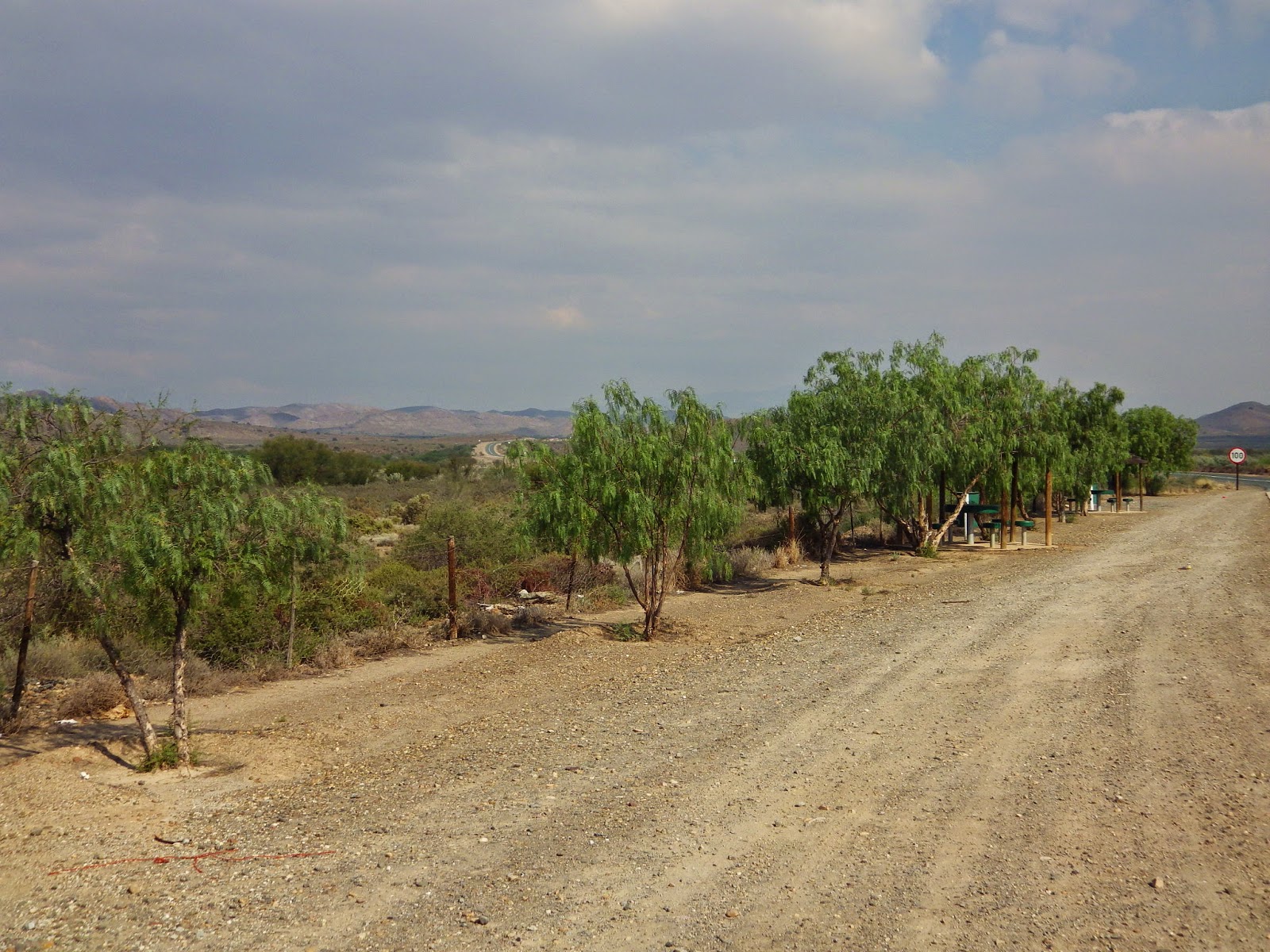
The R62 had not-very-scenic picnic pullouts every 5-10 km that were well marked – EXCEPT for the part between Barrydale and Ladismith. For some reason, in that 60 km section (around Ronnie’s Sex Shop, a famous pub that has nothing to do with sex that happens to be in the middle of nowhere but sells cold beer), there are rest areas, but they aren’t signed so you don’t know they’re coming. We therefore had to slam on the brakes to stop for lunch (God job for zero traffic on the N62 Route). The lunch spot wasn’t much; a roadside rest area…


A typical desert roadside pullout
…near the turnoff to the Touwsberg private game reserve…


Lots for sale? In the middle of the desert?
…which has lions, cheetahs, zebra, giraffe and African two-toed ungulates, where you can buy lot and build a house and have those critters bother you, if that’s your thing.

But the cool part about our mostly-uninteresting lunch spot was the birds. Nope, I have no idea what most are, other than the very cool Lesser Double Collared Sunbird (yes, we looked that up, and yes, it's a common bird here).


Our first sighting of a lesser double collared sunbird 
No idea 
No idea either 
Don't know who he is, but I like the eye ring
Several times through the day, we saw ostriches, starting near Barrydale and continuing almost to George. Now, they are farmed here, but at the same time, I know we saw some wild ones.


Adults in black, babies in grey 
Lots
The roads here just disappear among the vast expanses of desert.


The ostriches were just to the right
We crossed several mountain passes today, but our best “pass of the day” was the Huisriveir Pass…


Red rock and scrub 
It's 1,000' down 
Red rock and white granite 
A cool valley that probably has African critters in it 
The normal SA Parks pass sign
…where Karen found another cool bird.


We see lots of these guys
We passed through Oudtshoorn, home of a LOT of ostrich farms, and then crossed our final pass to the coast, the Outeniqua…


Wow. Green on one side, desert on the other 
That's the Indian Ocean in the distance 
Two roads lead to those passes 
A pass panorama
…getting to George at 3:15 PM, an seemingly unrushed 6.5 hrs from Stellenbosch.

We stopped for groceries in George (in the Garden Route Mall, which could have been a mall in northeast Calgary for all we knew), then headed to our home for the next 5 nights, Fairey Knowe Backpackers. We got half of this thatched roof cottage…


Thatched roofs are common here
…and this was our room.


Big, airy, but light on furnishings. And heat.
The hostel is “interesting” (a farmhouse older than my country) and pretty. They offer cheap in house breakfasts and dinners. Given our long driving day, we opted to stay here for dinner. Meh. Some kind of bland stew-like thing, which was overpriced at $7.50/person.

Route 62 is being promoted as an alternative to the N2 to get to the Garden Route, and it’s an awesome choice. You might be lucky enough to see critters on the way (we saw 5 baboon troops, more than 6 herds of wild ostriches plus plenty of farms, and a mongoose), but even if you don’t, it’s pretty darned spectacular scenery.

==============

Today’s Travel Tip: Speed limits

South African speed limits always seem to me to be 5- 10 KM too high. Great examples include 60 in towns, 120 on an undivided 2-lane road, and no school or playground zones. And we saw LOTS of cops doing radar work. One speed trap outside of George had 4 cars pulled over being ticketed.

On winding, twisty, steep grade mountain roads, you’ll suddenly find cars or trucks or transports doing multiple km/hr below the speed limit. If you do the speed limit, others may still pass you like you’re standing still. Slow cars and trucks may drive partially on the shoulder, enabling you to pass, but they may not. You are expected to drive on the shoulder (assuming there is one) if someone wants to pass you.

Monday, 4 May 2015

April 28 – Exploring Stellenbosch area wineries

Rather than explore the winelands around Stellenbosch & Paarl on our own, we decided to take a guided tour so I could drink without driving…

The tour we picked was a budget tour run by our sister hostel, called Easy Rider Wine Tours. Turns out that all 6 of the folks on today's tour were in fact staying at our hostel, which was convenient.

Wine tours can be risky since the “how we make the wine” stories are the same no matter what winery you go to. Believe me; having toured wineries in the USA, Germany, France, Chile, Italy, Argentina, Australia and Canada, it can get repetitive. The tour today visited 4 wineries (only one of which I have heard of) but refreshingly, had enough variety to keep you entertained.

The first winery we went to (Simonsig) grew cork trees, which I have never seen before. Cork trees don’t grow well in South Africa because the bark gets too soft in the area’s high temps, but it was neat to see one anyway.
The bark felt like cork, because it is
In many ways, the area reminds me of Napa.

Beautiful
Included in the tour was a very nice lunch in a café in Franschoek.

Elegant courtyard dining
Our touring companions were two young ladies from France but who were living in Brussels, and a young couple from Bavaria, all on a few weeks vacation, all heading our way towards the Garden route.

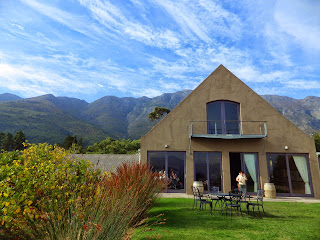
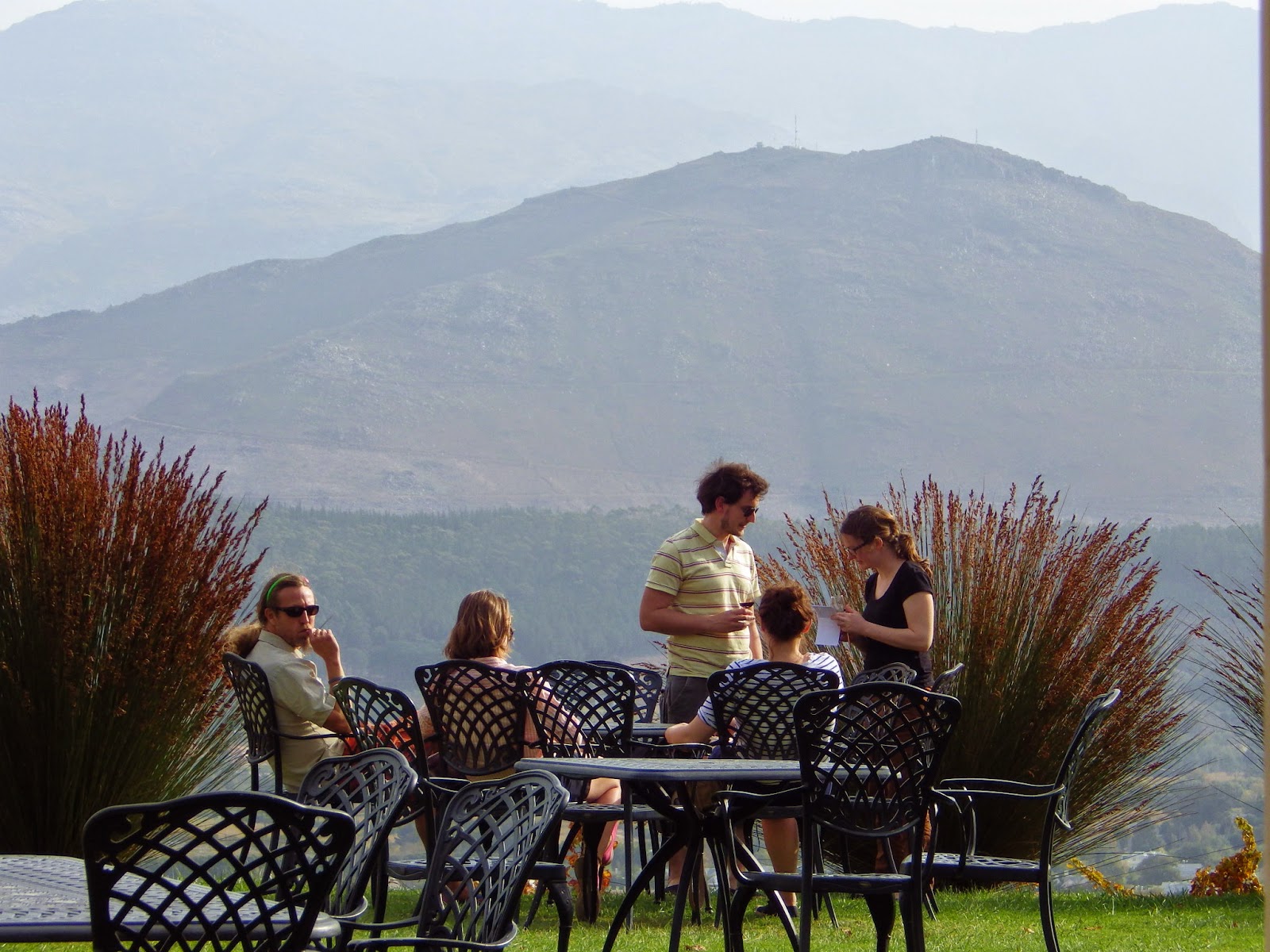
The Franschoek area was probably the prettiest, and the winery was set up on a hillside overlooking the valley.

Well, that's just stunning 
Vineyards and mountains 
Our tasting space. Take that, Kelowna 
Fall vines 
Die Donne 
The wine drinking team 
Stunning 
More stunning
One of the wineries we went to was housed in a building 7 years older than my country.

Older than I thought. Home of Zorgvleit Winery.
While we passed a few wineries I know or have heard of (Spier, KMV, Plasier du Merle), one winery we visited today (Fairview) was not just a winery, but a cheese maker, too, specializing in goat cheese. Their export brand: Goats Du Roam, available in Canada, and yes, they have a goat at the winery/cheese shop. 

He has his own climbing tower, too. He's Swiss.
Buzzing by wineries gave lots of views like this…

I love this photo
…but still, getting out and visiting the scenery was very nice, as was tasting +5 wines at each of 4 wineries. Which, for the record, is a lot of wine. A lot of very good wine.

Sigh
We liked the tour and the wineries, but our tour guide was less than enthusiastic about anything, not very talkative, and never seemed like he was enjoying his day. Our accommodation (Banghoek Place) is nice, though a long (25+ min), if safe, walk from downtown. In fact, we chose to drive most of the way both nights we went into town for dinner.

Our two dinners here were excellent. Our first night, we went to Basic Bistro, an awesome and inexpensive little place that was busy, busy, for obvious reasons. Our second night found us at a South African “chain” pizza joint (Col’Caccio), with about 200 pizzas on the menu. Good pizza, but a little pricier. I do like the fact that wine in restaurants here runs from $8 -$15 Cdn.

Wine in grocery stores starts at $2.70 Cdn and goes up to $12, so restaurants double or triple the price, resulting in wine you’ll probably still find cheap.

I could get to like eating here. And drinking.

================

Today’s Travel Tip: Minimum Wage

There are no laws regarding minimum wage in South Africa. At some restaurants, the waitstaff are not paid except for tips, and tips here are ~10%. In one upscale pizza joint we went to, waitstaff are paid $1.50/hr and get “most” of the tips. We’re pesky “tip 20%” Canadians. The staff love us. But then dinner for 2 including a good bottle of wine, 2 wonderful starters, 2 great mains and a decadent desert one night was only $38. So we splurged and gave our waiter $7. He mentioned that was “a lot”.