Monday, 9 September 2013

Burstall & South Burstall Redux

We were last up Burstall Pass in 2009. Eager to show my friend Monty the best of K-Country, we headed up her today on a route very similar to our 2009 excursion, with one major exception: we walked the whole thing, and did not use bikes. That may seem trivial to you, but the bikeable 3.5 km took us 2 hrs to walk back and forth today, when we biked it in less than an hour in 2009. So our day was a long one. We started walking at 10 AM, and 20.8 km later, we finished at 6:20 PM.

It got off to a good start though; we saw a moose on the roadside on the way down.
A horse? No. 
Lady moose, chewing
The perfect blue skies excited us, but by 11 AM, grey clouds had socked in.
The Robertson Glacier 
Crossing the plain
Getting across the glacial outwash plain in the morning was pretty easy, despite some "significant hazards".
Not the trail I would use 
The lake before the re-entry to the forest
We were readily able to rock hop the numerous creeks in the AM, and avoid the lake, by just doing a bit of exploring.

By noon, the clouds basically gave up, and the sun started winning -- at least in the sky coverage department. A brisk west wind kept it feeling cool as we climbed.
Looking back. Mts Birdwood, Pigs Tail & Commonwealth
The fall colours have already set upon the ground cover, but the larches have not yet started to turn.
Reds in the grass
Looking toward South Burstall Pass. Sir Donald still clouded
We cleared the pass, and headed to the Leaman Lake overlook (in Banff Park) for lunch.
Leaman Lake
Looking north up Spray Valley
From here, we headed south toward South Burstall Pass, with Snow Peak (a popular scramble) looking over us.
Snow Peak behind us 
The pass and Mt.Sir Douglass ahead
It's not a long or hard trudge up to the south pass. But it's worth it.
The Spray River & Palliser Pass 
Mt. Sir Douglas 
A close up on her glaciers 
Looking back at (l to r) Snow, Smuts, Birdwood, Pigs Tail
At 3 PM, we finally left the south pass to head back. At 4:30 PM, the glacial outwash plain was a might bit tougher than it was in the morning, with at least 3 more inches of water in every channel that widened them and created new stream flows to get through.
The glacier again
We had a few places we had trouble finding crossings for, including a 70' wide swamp of flowing muck.

So we wasted a bunch of time trying to find creek-hoppable routes, when we probably should have just sucked it up and waded the freezing cold, muddy water. On second though, that's probably why we didn't.
Confed, and the last of the streams.
It was a nice hike, and a great place, but a LONG hike, and a tiring one. Next time, bikes.

Saturday, 7 September 2013

Rain

I used to like rain.

I grew up loving to watch thunderstorms roll in over the Ontario countryside from the safe confines of a glider hanger. As as glider pilot, towering cumulus clouds thrashing and billowing in the sky were a joy to watch, and meant fun flying. A layer of low stratus may have prevented flying but sure was interesting to watch or listen to roll off the walls of my tents, tent trailer, or house trailer as we would hunker inside playing cards, drinking beer, sharing flying stories (or hiking stories, if we hiding from the rain while out on the trails).

Now rain has other meaning. On my new nascent forest and as-yet incompletely grown-in back yard, heavy rain means rivers of mud flowing towards my house, as happened last night.
Water breeches the retaining wall 
A muddy creek flows around the house, as designed
Rain now means "the basement could flood". Rain now means I could spend another month tearing wallboard out, and putting it back. We have worked hard at improving the drainage, but rain is a reminder that my basement walls still leak. Rain is a message to check the sump to see if water is coming in via the weeping tiles. Rain is a constant test of whether the fixes we did are good enough. Rain in an experiment as to whether the eavestroughs are all cleared and working.

It's interesting to watch the Facebook comments of the people in the Bow Valley now as a heavy rain event like the one we're currently having occurs. Will the creeks overflow again? Will the culverts block? Will there be evacuations? Did the temporary repairs the towns and MD put in place do their jobs?

Six months ago, a forecast of 50-70 mm of rain in a day would have been looked at as an annoyance -- no mountain biking or hiking for a day. The flood changed that. During the June flooding event, we had 200-300 mm in a 48 hr period, and it wiped out a portion of our world. Now we ask, "What will half of that do?"

We get to wait and see. The waiting is the hard part. Sadly, we all now are trained experts in flood response.

Friday, 6 September 2013

Reforestation

When we volunteer with the Bow Valley Stewards or the Friends of Kananaskis, we commonly refer to it as "gardening in the woods". We pull out unwanted plants like noxious weeds, or tear up the forest to build trails. Sometimes, we do the opposite, planting trees at wildlife overpasses to make them more appealing for wildlife, or in the middle of rogue trails to make them "go away".

Karen always jokes that we do that kind of work as volunteers but never do it at home.

Well, it was time to change that. For the last year, my yard has been a disaster. It started way back here with the first of the heavy equipment digging a new basement section, and got worse here just before the floods started when we finally re-graded the yard. I threw down some grass seed after the floods as a temporary measure to stabilize the soil until we could fix things properly.

This week was "fix things properly" week. We planted a total of 10 trees, plus a bunch of other stuff, including a small collection of native alpine flowers. We got all our plants at Bow Point Nursery, who specialize in nothing but local, native plants grown from seed without irrigation. In the end, we did plant one non-native tree (a Siberian Larch), but we have 3 of them already and even Bow Point sells them.

My car could only carry about 6 trees at a time, so we took 2 days to do the work. Our friend Monty helped us on the first day.
Monty and I digging holes 
Some stuff in and finished on Day 1
We had already planted 3 sub-alpine fir that we rescued from a trail building project we did last week. We pulled them out and were going to throw them into the forest to die, but instead brought them home in a bucket and planted them.
At the end of planting day 2 
My nascent forest
After we were done, I threw some more grass seed in the bare patches we created, and also where the original seed had not taken well. We also added some more organic rich covering in places where our yard is clay and rock. Digging the holes, I was astounded at the variability of the soil in my yard. We found black organic stuff, sand, clay, gravel and rock, and everything in-between.

In total, we planted:

  • A Douglas Fir. I have one that is 60' tall. Now I have one 4' tall, too;
  • A Tamarack and a Siberian Larch. Both turn beautiful yellow and lose their needles in the fall. The tamarack is more typical in eastern Canadian, but this is the western limit of its range. Larches are beautiful trees, but the high alpine Lyall's larch that we see on the trails here doesn't grow below 1,800 m altitude (we're at 1,375 m);
  • 2 Paper Birch and 2 River Birch. I already have a VERY happy 30' tall River Birch that the birds love and turns pretty fall colours, too;
  • 2 Dwarf Poplar. These poplar don't sucker, don't grow too high, and get nice and bushy;
  • 3 rescued sub-alpine fir. They're really small right now, and came from 1,700 m in a dense, damp forest. Here's hoping they survive;
  • 3 shrubby cinquefoil, better known as native potentilla. We have some hybrid potentilla in the front yard that don't ever flower. These will;
  • A green alder. Alder like some shade and damp ground, and get very dense;
  • 2 blackbud willows. These have bright red stems all winter, and the birds love them;
  • A Louise willow. Actually from a seed source in Lake Louise.
There's also 4 or 5 trembling aspens growing up in the middle of everything from suckers of an aspen tree I have. We'll let them grow as long as they don't bug us. The grass underneath it all is native sheep fescue, which doesn't need mowing and doesn't get more than 6" high.

So in short, we now have a zero maintenance yard.

In about 5 years, we should have a genuine forest. Until then, it looks pretty nice anyway, and will offer a mix of sun and shade, cool colours in our short fall season, and let in lots of winter sunshine. We may continue to transplant in baby pine trees that grow like weeds in our hamlet (I have at least 5 in the front yard to pick from, all a foot tall) if my forest needs more.

All that's left is to finish the fence and build a big gate. That's a project for next week.

Thursday, 5 September 2013

Going Up Grotto Canyon

My friend Monty has a visitor coming who likes hiking but can't go too far. On Monday of the long weekend, we decided to try out two short trails to see if she if she would be up to them. One I wrote about earlier, Troll Falls, is fine.

The other, Grotto Canyon, is always of interest to locals. It's a popular short walk through a slot canyon past petroglyphs to rock and (in the winter) ice climbng areas.

Well, if you have been there before you won't really recognize the place. The trail has always been in the canyon, but the canyon hasn't always been filled with boulders, and in fact, it used to have a tree or two in it.
Looking back from the entrance to the canyon at the flood damage 
Inside the canyon
That never used to be there
The short section of the canyon prior to the waterfall -- the most popular section with day use folks and climbers -- has been scoured. Like Heart Creek, the creek is in different places. Climbs now start over water. Pitons now sit at knee level, as gravel created banks that never existed before.

The T junction by the waterfall hasn't changed, and the two weeping walls that form winter ice climbs remain fine.
I think they're called His and Hers
Most day wanderers don't go past here, but we did. The canyon turns left, through an even tighter rock slot that used to be interesting walking but is now just filled with rubble.
The first part of the slot
Just to give you an idea of how deep the water was in here during the flood, there are banks of leftover gravel that are 8+ feet deep.
One bank. Karen for scale.
A short section of tight slot canyon, and you used to break out into a wide flat valley with lovely dryas/aven mats, pretty flowers and pleasant walking on a nice trail. All that is gone. The valley is now wall to wall boulders, with the odd mess of fallen trees thrown in for variety. There is no trail; you just pick your way through the debris.
Trail? What trail?
A log jamb
There have always been hoodoos back there, one of which held a rather large circular shallow cave. That cave is still there, but circular it is no longer, having partially collapsed.
The cave. The wall below it has eroded substantially 
The thing that fell in the cave
We didn't go past the cave, and in fact, I rarely go past the cave. The valley of rubble without a trail continues, but we never do, even when there was a pleasant trail.

There are still bits of forest on small sections of the 10' tall creek banks that were not eroded. They hold illegal campsites. We found at least 2.
A chair and firepit. 
A campsite built for 20
I used to like hanging out in the upper canyon. The dryas was pretty in the fall. I doubt we'll spend much time back there any more.

Catching Up: A Rome Summary

A friend of mine is off to Italy soon, and I thought to myself "I need to get her to read the Visiting Italy summary I wrote." I went to send her a note with a link to it, but realized that while I wrote it, I never posted it. My bad. So here, finally, 3 months after I wrote it, is my Rome Summary. 


Having stayed in Rome a month, here’s some info to consider if you’re planning a visit to the Eternal City of any duration. Call it "My Visitor's Guide to Rome"

Metro: good. Trains: good. Trams: good. Busses NO. Rome’s city busses are everywhere, but the one you need isn’t. No one can tell you when the bus you want will come, and it’s really hard to know where a bus is going, when it will pick you up and get there. Sundays are a terrible day to ride the bus; some lines don’t run at all, some have different routes, some ply the same routes but don’t stop where they do every other day. Busses are packed, always. Rome is a big city and you have to get around, so you will take some kind of transit, like it or not.

So pick where you will stay based on at MOST two considerations: 1) How far is it to the nearest metro or tram stop? If it’s more than a 10-minute walk, stay somewhere closer. And 2) How close is it to Termini?

Your distance to Termini is critical if you want to go anywhere (except central Rome or Trastevere), because being 9 stops away from Termini by Metro adds an hour to any journey you want to take from Termini. There are some really cool things outside of the center of Rome, and no matter what they are, Termini’s probably where you have to go to get to them.

  • Tivoli? Bus from Porto Mammolo, via the B Line from Termini.
  • The Colli Albani? Via the FR5 train from Termini.
  • Ostia Antica? Via the B line from Termini.
  • The Cittavecchia cruise ship terminal? Via the FRX train from Termini.
  • The aqueduct park? Via the A Line from Termini.
  • Anywhere on a day trip from Rome, such as Perugia or Orvieto? Via a train ride from Termini.

All roads may not lead to Rome, but all roads from Rome leave from Termini.

Walking in Rome is commonly a challenge. There are virtually no sidewalks, and where there are, cars park on them. You will learn a new way to cross busy streets, ignoring lights and walking at will through busy traffic as the Italians do. Walk like an Italian. Defying death on a day-to-day basis walking through rushing traffic makes life interesting, and more like living in Italy. And you will walk. A lot. On cobblestones. I cannot stress how this calls for good shoes. Every time I have come to Italy, I have brought my best walking shoes and gotten blisters.

There are bank machines (Bancomats) everywhere. They take your ATM card from home. They all work in English. They are all easy to use. They all spit out Euros.

There are grocery stores everywhere, but they’re different than you’re used to. Most -- especially near the center -- are not big, but most are bigger than they look from the outside. There are no big signs advertising them, and so you need to know what you’re looking for: Despar. Carrefour Express. Todi. Pam. Punto. All are good, and open Monday to Saturday from early to late. Some are open Sunday. All sell beer, wine, picnic stuff, terrible bread (see below), toilet paper, and everything a grocery store normally sells. There are plenty of fruit and vegetable markets and stands; many are only open in the morning, however.

Your choice of restaurants here is simple: Italian. I saw more Chinese, Japanese and Kebab places than I have before, but that’s about it for cuisine. Still, you don’t come to Italy to eat Thai food.

Italians eat the most amazing lunches and dinner, but eat crap for breakfast. Stand up, eat a croissant while the cappuccinos being made, and drink cappuccino. In and out in 5 minutes. Done. Italians take breakfast in a bar, and I don’t care if you don’t drink, the best breakfasts are in a bar. It’s bars that sell killer cappuccini and croissants. Note: it’s a bar. Some Italians actually do have wine or beer with breakfast. And this ‘aint Starbucks. There’s a price if you stand, a higher price if you sit. Stand. Be like them. If you insist on sitting, realize that the incremental price of the coffee buys you the table. You are allowed to sit all day and I swear they will not bother you. Don’t feel obligated to keep buying stuff. So only sit if you want to stay a while (more than 15 or 20 min).

When eating out, Italians are eating fewer 6-course meals, even though the menu is still structured to accommodate 5 or 6 course meals (antipasto - pasta - 1° - 2° - contorni - dolci). It’s OK to not have 6 courses. Antipasto, 1°, dolci is fine. Most pastas are now incorporated into the 1° portion of the menu, and the pasta serving sizes (which used to be small) are getting bigger. However, the 2° dishes still really need a contorni (side dish). Set tourist menus are OK and generally a good deal, but don’t be surprised if the restaurant shows them outside but not on the regular menu when you get inside. If you want that menu, ask for it. 

In real (non-touristy) restaurants, you won’t get salt & pepper on the table, nor will you get oil and vinegar, and you will get dirty looks if you ask for them. Italians think their food is seasoned perfectly, and view your attempts to change it as an insult. 

Most Italians don’t tip much, and you don’t need to either. If paying cash in a restaurant, rounding it up to the nearest 5 is fine, and you DON’T leave the tip on the table at the end like a North American. Just pay.

Covet €1 and 2 coins, and 5 notes. Collect them, carry them, but use them where change is a problem. Most places that sell tickets for attractions don’t have change, and all the tickets are priced not in convenient €5 increments, but instead have prices such as 7 or 11. In a street market, pay cash, and don’t dare try to pay for 1 of bananas with a 20. However, a supermercato is a great place to break big bills and get change.

You get a lot of things in a tabacci. I don’t care if you don’t smoke. Tabaccis sell transit tickets, phone cards and other useful stuff.

If you have the opportunity to have a porchetta sandwich, try it. Roast pork. You will be happy forever.

Italians make awful bread. The only thing it’s good for is to toast and put diced tomatoes on (bruschetta). Their rosette buns are particularly poor; stale before you get them. Their version of a baguette is a huge disappointment if you’ve been to France. If I could teach the Italians one thing, it would be “Go to France and learn to make French bread”.

Italian napkins are terrible, especially the ones in bars. It’s like they’re plastic coated. They absorb nothing. If I could sell Italians one thing, it would be better napkins. And thick aluminum foil. And Ziplocs. They don’t have Ziplocs. In fact, you can’t buy plastic baggies as you know them. Okay, there are a few things Italy needs.

Wine isn’t one of them. They have lots. It’s cheap. A really expensive wine in Italy is 10. Most are 4-6 and many are under 4. Wine also comes in boxes, including drinking boxes (though mostly whites in that size) and half-liters. And some markets offer BYOB wine: bring your own bottle (such as a 2 l pop bottle), and they will fill it with wine. Trionfale Market has 2 of these places. Wine for 1.30/l.

Beer’s just as cheap – as little as 1.40 for 3 x 330 ml bottles. But they only sell little bottles (330 ml) or big bottles (660 ml). And the most you can get is a 3 pack of little bottles. But the beer isn’t very good. Peroni and Nasturo Abbuzi that are readily available everywhere are blah rice beers. But they’re cheap.

And since bars sell beer and wine at all hours of the day, and they drink it everywhere, so can you. Don’t even hesitate to have a picnic with wine somewhere. People drink beer on the street all the time.

I don’t for the life of me understand why you can take pictures in some churches and not in others. And they will yell at you or kick you out if you try where you can’t. So read the signs when you go in, or ask.

Italians just generally dress better than you, and all the scarves and leather jackets you buy won’t make you look like them. Tourists stand out like sore thumbs, especially tourists trying to look Italian. I’ve noticed over the years that Italians stand out less; there was a time when they just looked WAY better than us all the time without effort, but this trip it was clear that American “dress like crap” culture has taken over, which is a shame. You will still see mind numbingly well-dressed Italians wandering around (the stylish women in their 4” heels floating effortlessly among the cobblestones are a thing to behold), but there are fewer of them. I promise to do a post of photos KC and I took of Italian women in their fancy Italian shoes.

Rome is FULL of stuff to see and do. We were here a month and didn’t see half of everything. Don’t try. I’m not going to list everything to see and do here; that’s what guidebooks are for. But I will list some of our best Rome experiences:

  • Porta Portese market. It’s where we bought most of our souvenirs. Reserve a Sunday. It’s worth at least 4 hours.
  • Trionfale Market. North of St. Peters. Best “new” (non street, mostly indoor) food and vegetable market in Rome. Not a lot of tourists here. Far better than Testaccio. Bigger and more interesting than the Campo dei Fiori market. Hit it on a Tuesday morning and visit the nearby flower market, also off the beaten track.
  • St. Clement church. If you only go in one church, make it this one.
  • Getting out of town: Castle Gandolofo & the Castelli Albani. Tivoli.
  • Ostia Antica. Easy to get to, better ruins than Pompeii. Better than the Forum, too, but you’ll go to the Forum anyway.
  • The Cappuccino church and its weird crypts decorated with thousands of human bones.
  • The trip to the top of the dome of St. Peters. An architectural marvel. Fabulous views. Great gelato on the roof of St. Peters. What more could you ask for?
  • Coffee in a bar standing up at the counter. But never drink cappuccino after 11 AM. 


And here are our top Rome disappointments:

  • The Spanish Steps. Tourist hype. You’ll be in the area anyway for other reasons, so no matter.
  • Trevi Fountain: Horrible crowds, and while the fountain’s nice, there are better ones (like Piazza Navona; almost as crowded but worth it)
  • St. Peter’s (the church, not the climb to the top of the dome). I know it’s heresy saying this, but St. Peter’s is less impressive than many other churches in Italy, notably the ones in Florence and Sienna, and many other churches in Rome (like St. Clement, with a church over a church over a house). You’re going to go, so I’m just sayin…
  • The Ara Pacis. A whole expensive museum dedicated to one thing. One interesting thing, but one thing.
  • The Etruscan museum. Highly regarded by many, but too many rooms of repetitive pottery bits. In hindsight, heading up to where these were found, an hour’s north of the Rome in the Etrucscan necropolis of Cerveteri would have been a good daytrip.


Tuesday, 3 September 2013

Catching up: Deja Vu Hiking (with Pikas!)

I am out of date on posting, so time to do some catch-ups.

It has been a slow year for us, hiking-wise. Normally by this time of year, we would have hiked around 250 km and climbed over 9,000 m; we're only at 135 km and have climbed just 5,300 m. And we seem to do the same hikes over and over again -- not that that is an issue, because we keep repeating good hikes, mostly.

Like, for instance, Rummel Lake and Pass. We went up there on August 16th as I wrote about here -- then went back there on August 24th with the Sunshine Snowhosts.
The gang crossing the cliff wall 
Wandering in the meadow 
Hanging at the lake
I ordered wildlife for them, and was not disappointed. We found several spruce grouse (I actually kicked one on the trail), some pika (that I couldn't photograph), a pair of white tailed ptarmigan...
Hiding in plain sight
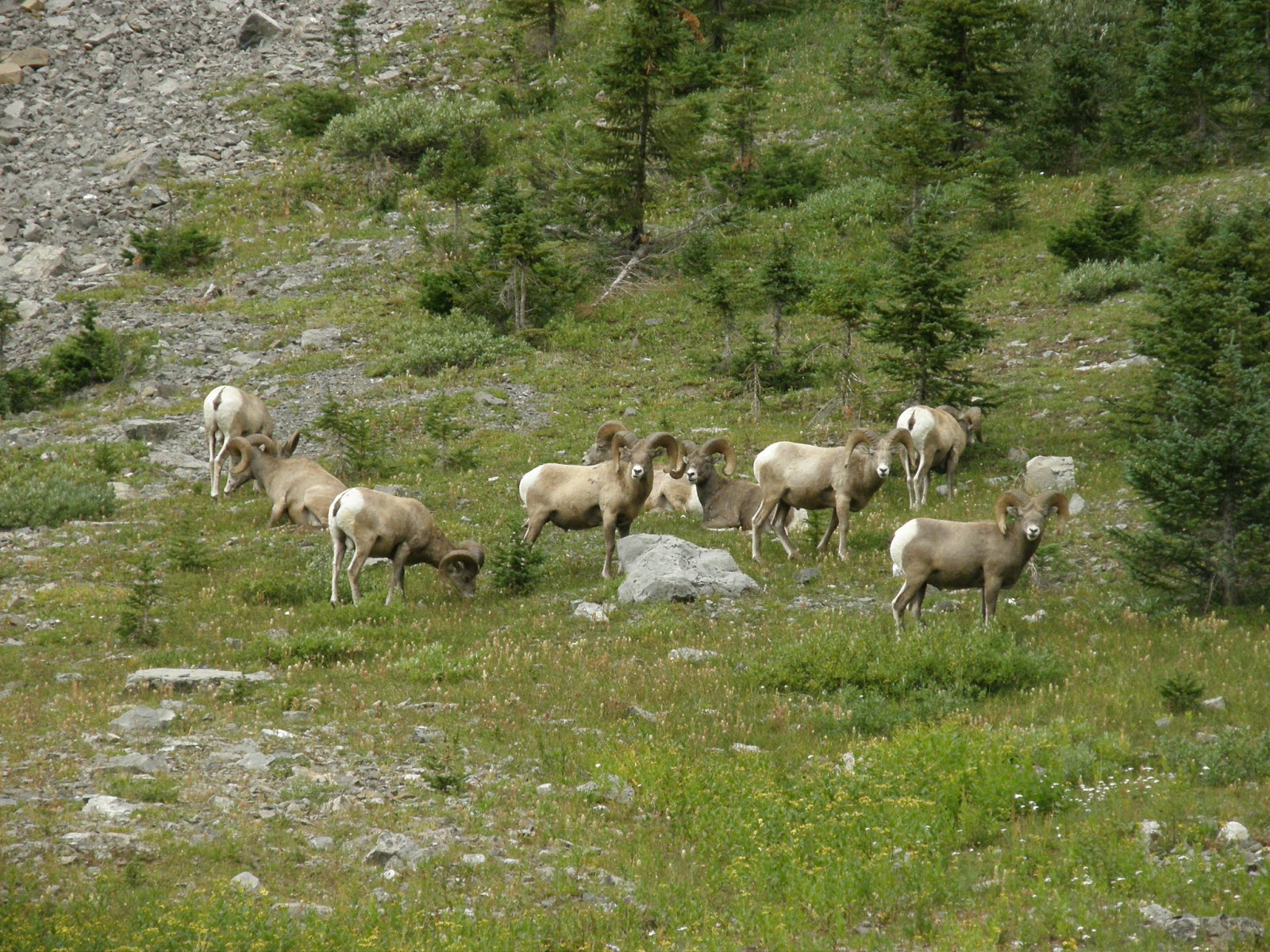
...and a whole herd of male bighorn sheep.
Munching in the meadow 
Paying attention to us, while we watch them 
A trophy sheep
That guy sitting in the last picture is a trophy quality ram if you're a hunter. Here's hoping he stays inside the provincial park where he can't be hunted.

The next hike we did was to take our friend Monty up Spencer Creek on August 30th, when we had just been there on August 6th. There was less water in the waterfalls, more marmots running around, a pika, and the fall colours were already starting -- but otherwise it was just as much fun as last time.
The reds and yellows have started 
The bathtubs of the upper creek 
Mt. Nestor over Spray Lakes 
Two of the family of 4 marmots 
A pika yells at me 
Extraordinary red leaves 
The col between Mt. Lougheed & Mt. Sparrowhawk 
Monty gawks at the scenery
Like the last time we were here, it rained on us on the way down.
Mt. Nestor now in clouds 
Those weird swirling clouds that only happen in the mountains
Monty wore a lime green raincoat that almost blended in with the luxuriant green of the mosses in the creek bed.
Mind-numbingly green
Then yesterday, we hiked the short Hay Meadows/Troll Falls loop, where we had done a Wildlife Ambassador rove on July 21st.
Troll Falls
We also went up Grotto Canyon, but that's for a different post.

We always seem to be going to the same places this summer. The grizzly project keeps getting us to the exact same bear camera sites, too. Karen has visited some sites three times, but has a number of sites she's never been too, and I'm the same way.
Grizzly hair on a tree 
Enough on this one to braid it
I blame the lack of hiking on the floods.