Saturday, 2 November 2013

Can anyone help me solve this puzzle?

My old backup camera, an Olympus 560UZ, is suddenly acting up. There are two problems, and I can't understand or diagnose either. Neither is in every photo. I'm going to post some example sick photos that demonstrate the problems, plus other photos of what things should have looked like.

Problem 1: Red tones appearing where they shouldn't.

Example set 1:


Almost normal 
WAY more pink, especially the clouds
What it really looked like, taken by Karen's camera
Example set 2:
Pink spots in the clouds... 
...that are gone 90 seconds later
Example set 3:
Mt. Lassen in it's pink glory 
Taken seconds later. Not pink.
Problem #2: Smeared whites

Example 1:
Very tall police car fenders.
Then things get REALLY ugly when both problems happen at once.
That's the front ranges, that have grown REALLY tall and pink
More VERY tall pink mountains
Pink clouds, white smeared wings
I have tried fixing these problems by playing with white balance and ISO settings, to (mostly) no avail. Things look fine in my electronic viewfinder and rear LCD display -- until I press the shutter button. The captured picture is terrible.

This only started happening, and is an "occasional" thing (not every picture has the problem) -- though recently, it's happening with greater frequency.

So, smart people who are also photographers: what's the diagnosis? Sensor gone?

Friday, 1 November 2013

Accidents on the way home

It was an unexpected way to arrive home from Maui.

We were driving home along the TransCanada, passed over Jumpingpound River about 30 km west of Calgary, climbed up the "Green Drop" hill (a hill where the Green Drop lawn care company has mowed into the grass their logo -- bypassing the "No Billboards" law we have here), crested the hill to find...

...cars slamming on their brakes. Debris on the road. Smoke. A truck overturned laying across the road. Fire in the ditch. And only ~6 cars between us and the mess, meaning it JUST happened.

I called the RCMP -- and was the first to do so. A 4 minute call. Karen ran back to start waving down the oncoming traffic -- doing 120 km/hr coming up a blind hill to a catastrophe scene -- to try and stop secondary collisions. She sent someone forward with a fire extinguisher. The flames are put out while I am on the phone.

The first RCMP arrived just as I finished the call. I grabbed my first aid kit, cursing myself that my big emergency kit (with flares and reflectors and vests and stuff) was at home, removed to make space for luggage to go to Maui. I ran to see what I could do.

One victim. A truck driver, prone on the pavement. Diesel fuel and debris everywhere. Two people helping the man, both trained in first aid. I announced I had first air training and asked if help was needed. Shoulder injury, hip injury, numerous facial lacerations, spinal involvement, lucid but quiet. He had no idea how he got out of the truck. The two Good Samaritans were supporting the victim's head and arms. He complained of being cold in the 50 km/hr, 7° wind. I wrapped his legs in my down jacket. An Irish lady, trained paramedic, arrived. Pulse check. Strong but slow.

More RCMP and Sheriffs arrived. Some took photos. We stayed helping the victim. They brought disposable emergency blankets. We placed supports under his feet.

Then the fire department arrived. One firefighter took over from one of the first volunteer responders. Standard questions asked to assess head trauma. Radio calls.

Then EMS arrived, and it was their turn. A re-check of vitals, standard trauma checks and more questions. More radio calls. EMS started to cut the victims clothes off. Abdominal bruising. A second ambulance arrives. The victim is rolled onto a backboard, and clearly this wasn't fun for him. A neck brace is installed. We volunteers back away as we are no longer needed.
iPhone capture of the scene at that time
And we wait. The victim is taken into an ambulance and out of the wind and cold.

Then STARS arrives.
Crappy picture, but you get the idea.
I think about this. STARS takes off 2 minutes after getting a call. Flight time to this spot is 7-10 min in that helicopter. So STARS was called 9-12 minutes earlier -- about 90 seconds after EMS arrived.
One firetruck has moved. STARS waits.
STARS departs within 5 minutes of landing.
Horrible grainy iPhone 4 max-zoom of a real life mess
The RCMP and Sheriffs clear a way past the mess, and we are released to drive home. We were not witnesses, and have nothing to add to the investigation that has already started.

What the heck did happen? Who knows. But it was blowing 50-70 km/hr winds, and that gravel truck with its pup trailer were empty. Did a bad gust of wind cause the trailer to swing out of control? You can see it upside down in the ditch, and the guardrail's a mess. The truck obviously rolled, but landed upright.
100 yds of decimated guardrail
But the truck has stopped way too close to the start of the guardrail damage, and was most clearly doing over 100 km/hr. So did he get into trouble earlier? Will the victim live?

We won't ever know. Maybe the RCMP will. The highway was closed for at least 3 hours after we got let through.

And it made the news. Areal pictures from Global. Stories on the CBC and CTV -- and yes, that's my photo on the CTV page.

Not the best way to arrive home, but at least we were able to help.

Thursday, 24 October 2013

Watching Real Experiments in Alternative Energy

I spent 32 years as an engineer in the oil and gas industry, but have always had a belief that renewable energy, such as solar and wind power, have a definite place in the energy mix -- though perhaps not as big a place as some would hope. I'm sitting on Maui. It's windy, it's sunny, there are waves and perhaps even the opportunity for geothermal power. You'd think this would be a great place to see a live experiment of the technology in action on a large scale, and it is. Maui Electric Company has provided some excellent information on their website that should serve as education for all alternative energy fans (and folks who don't like oil and gas). Click the links as we go along here to see the experiment's result in action.

My personal reluctance to fully embrace alternative energy, by the way, comes not from a love of oil or gas, but an understanding from an engineering perspective of the limitations of every source of energy we use, and you can see those limitations live on Maui. Take wind power, for instance.

It seems pretty benign, having big windmills up in the sky over land or sea. But windmills do a major serious number on birds -- especially raptors -- and bats. Maui's 51 MW Kaheawa Wind wind farm's environmental impact assessment makes it clear that the wind farm will kill endangered nene (goose), bats and other birds. They are permitted to kill only specific numbers of birds a year or risk being shut down. Wind farms have a track record of killing off or creating "no-fly" zoned for raptors that control rodent populations, with corresponding adverse consequences on agricultural yields. 

Windmills have downstream effects on weather patterns. Large wind farms in California have resulted in decreased rainfall in the lee of the farms.

Not everyone loves wind farms. Take these guys, for instance, trying to block a wind farm near Ottawa. I remember reading complaints about the Kaheawa project in the Maui News before the project was built.

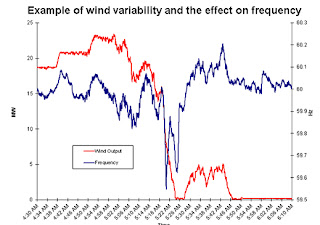
But the biggest issues from an engineering perspective is that windmills only work when the wind blows, and far more importantly, change their power output with every minor change in wind speed or direction. See just how variable it can be here, or just look at the picture below (take a careful look at the X-axis scale).
It dropped from 22 MW to 0 MW in 20 minutes
Understand that electricity demand on a large scale (like the entire island of Maui, or the State of Hawai'i) is pretty constant. On Maui, it's almost dead flat from 9 AM to 7 PM, then it spikes a bit before falling off. You can see the demand curve here. Every slight variance in wind speed results in a fluctuating input to a system with a steady draw. Something has to "fill that gap" (on Maui, it's oil, because you can store it, and turn the burners up and down quickly). Maui's wind farm provided 13% of the total system electrical supply in 2012; that number will be higher in 2013 because of the Kaheawa Wind Farm's expansion.

Solar (referred to on Maui as "PV, or photovoltaic) is even worse from a variability perspective. Solar only provides power on a curve that starts at sunrise, peaks in the middle of the day, and falls off to sunset, changing whenever a cloud comes by. That demand link I gave above or you can see here shows the solar insolation profile. Again, there's big differences between the potential PV supply and the demand curve.

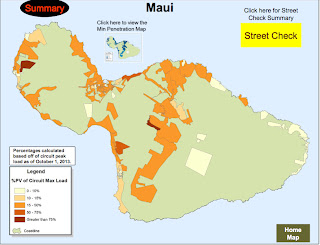
Still, tax incentives have encouraged people to put PV panels on their roofs -- Hawai'i is a national leader in solar power -- and Maui is full of PVs. There is 4,300 MW of installed PV capacity on Maui. See how fast PV has grown here. But how full is the system? Again, Maui Electric shows you. See here for access to full sized pictures for the whole state; a small version of the two critical maps for Maui are below.

Map 1: Installed PV as a percentage of minimum daily electrical load:

The darker the blue, the more PV there is. Note that there are places -- lots of places -- where PV generation capacity is in excess of minimum electrical use. These neighbourhoods are net "exporters" of electricity to other neighbourhoods (when the sun is shining). That is to say, on a daily average basis, they generate more electricity than they consume  -- but of course, at night, they are importers of electricity fueled by something other than solar (in Maui's case, wind, if it's blowing, or diesel).

Map 2: Installed PV as a percentage of total circuit load:

The darker the orange, the more PV exists as a percentage of the total capacity of the wires to take that generated electricity to somewhere else. Note that there are two places where there is so much PV energy generation capacity that the grid can't take it away.

Maui has said that if the PV represents less than 15% of the total circuit's carrying capacity, you can freely put a PV system on your roof and make all the energy you want. Not much of the island is left that can do that (primarily Wailea, Makena & Kapalua). Any more than 15% and you have to go through a process for approval. Why? Because the high variability PV makes for incredibly difficult electricity balancing. Electrical customers don't want brownouts whenever it's cloudy or the wind slows down.

So Maui's learning: if you don't have much wind or solar power as a percentage of electrical demand, adding it is easy and makes sense. But over 15% and there are problems. See how bad it's getting on Oahu here. Don't believe all this? Have a read of this Scientific American article on the topic.

We like to think electricity is easy and clean and nice. But there are LOTS of engineering problems with electricity (line losses, inefficient conversion from potential to kinetic energy, etc), but the biggest is you can't store it. Push an electron into a wire and an electron has to come out somewhere. Battery technology gets better all the time, but big deal, it's WAY too expensive and results in massive energy loss through heat. In 2012, we visited the Taum Sauk pumped storage reservoir, where excess electricity generated is used to pump water up to the top of a mountain, to be let out during peak demand. In an engineering sense, extremely inefficient and massively wasteful of energy, but you could do it here (so long as someone will let you build a lake on the top of a mountain). Maui Electric looks into pumped storage and other energy storage options here and here. Oil's easy to store. It comes stored.

(Aside: As an engineer, I think they should consider using excess electrical energy to electrolyse seawater, split it into oxygen & hydrogen, recover the hydrogen, then store that and burn it instead of oil. Electrolysis takes a LOT of energy, a by-product is bad chlorine gas, hydrogen is too volatile a fuel to use in anything other than an industrial application, and when you burn it all you make is water on an island that needs water. Perfect where you have a lot of seawater, a lot of wind power, a need to purify drinking water, and the only generating station sits on the shoreline -- but that's just me).

An article in today's Maui News announced that Hawai'i Electric just received a million dollar grant to study ways to improve forecasting associated with PV unpredictability (I'd link it, but the Maui News is no longer free on line). The issue of electrical grid balancing with PV or wind is so significant here that Maui Electric and partners are running some experiments. They've teamed with a Japanese company in my neighbourhood to sign up houses with PV system, and 200 Nissan LEAF electric car owners, to try to put in some high tech stuff to balance out the grid. It's gonna cost millions just for one little neighbourhood.

It's a wonderful feeling to tell people that you're "net negative" in terms of electricity -- that you make more than you use -- but it's misleading to suggest that means you've weaned yourself off oil and gas. Until viable storage systems exist, at anything other than full direct sun, or when the winds aren't blowing steadily, you're still reliant on the oil and gas you claim you can do without. Someone I know just posted this:
If you do not like pipe lines and the dirty tar sands mess, I am thinking that there is a great lesson to be learned from the T'Sou-ke First Nation on the south tip of Vancouver Island. The 40 home Reserve is now energy independent by making use of solar panel arrays. Chief Gordon Plances and the entire Souk community should be commended. They are not only energy indepependent but are also producing the hot water needed for residents. The 75 kilowats produced on the Reserve are sufficient to export electricity to the British Columbia power grid.
Nonsense. That 40 home reserve is not "energy independent". Between 7 PM and 6 AM, and any time it's cloudy or calm, they are wholly dependant on hydro power (you know, that stuff that makes dams and floods valleys that people fight against) and oil and gas. And they will be basically for a long time to come. The "great lesson to be learned" is that oil and gas won't go away any time soon. Commended? Sure; every little bit is going to help in the issue of the long term supply of viable energy. But they shouldn't be carried off on anyone's shoulders for being able to rip up pipelines and stop oil and gas production. Far from it.

Wind and solar are cool technologies, but the reality is, they will never fully replace oil and gas without massive step changes in energy storage technology -- and Hawaii and Maui might not even get to their 2030 target of 30% on average. I say that not as an oil and gas weenie but as an engineer who understands the limitations of the technologies. Anyone who doesn't believe me simply needs to look at the live, real-time, large scale (not 40 home) experiment going on in Maui or Hawai'i -- a place where the wind blows, the sun shines, the ground is hot, the waves move -- and oil and gas will make up the lion's share of the energy supply for a long time to come.

October 2015 Update: Hawai'i as a state just broke the 15% penetration and changed the rules. In order to manage rooftop PV, you now have to provide battery storage, or you can't feed the power back to the grid. Remember, it's PV feeding into the grid that screws it up. See the news info here. They call it "the death of solar". Oahu hit the cap first, but Maui's close.

February 2017 Update: Maui County's plan to go to 100% renewable will cost $10 Billion.

Monday, 14 October 2013

Hanging around upcountry

You can't spend every day on Maui on the beach. Well, you could, but you would get sunstroke and sunburn pretty quickly if you're a "white guy" from a less sunnier clime like me. 

At least at the beginning of our time here, every few days we take a break from the beach and head upcountry, to at least the 1,000 - 2,000 m altitude mark. A lot of folks live at the low end of that, there's are some nice parks, and pretty views beneath the omnipresent clouds.

On the Sunday of the Columbus Day weekend, there were also lots of locals out having fun. One park we like to picnic at was packed with folks tobogganing. Yes, I said riding toboggans. Or in their case, sheets of cardboard.
Some up, some down 
Face first 
The line up at the top of the hill 
Three at once
Which begs the question: do Albertans toboggan on grass hills in the summer? Or do they strictly reserve tobogganing for winter?

There were even kids riding skateboards on the grass hills.
One standing, two sitting
There were a LOT of people near Rice Park. Across the road, the Kula Country Market had a corn maze and pumpkin party going on.
Pumpkin picking 
Popular...
The main reason for us to go upcountry is to go find native birds in what's left of the native forests, and for that it was a jackpot day. We must have seen over 20 'Apapane in the blooming ohi'a trees. The trees were great, the birds having a riot in the blooms.
'Apapane 
Another 
Close up of the blossoms
The upcountry forest was it usual misty weird self.
The clouds swirl
Clouds arriving
Normally, we walk the whole Waiakoa Loop trail, but today, we just did a 5.5 km out and return to see the birds. I don't think I've ever seen so many ohi'a trees with so many blooms, and lots of baby ohi'as are starting to grow in the pine forest.

It was 91° F when we left Kihei, but only 63° F on the trail, where we peaked out at 1,950 m altitude -- kind of the same altitude I hike to in my neighbourhood at home. It did not feel cold at all, and surprisingly, there was no snow...

Wednesday, 25 September 2013

The finished fence

Because I took you through the first 4 days of the project, I figured it only fitting that we finish it together.

When last we left, all that was left to do was the gates. Gate 1 had been framed on Day 4, but not hung or had boards attached.

We used those gate kits you can buy that claim to not allow the gates to sag. This is the second time I've used them; this kit was easier to put in but doesn't seem nearly as sturdy. While they seem to work fine, they're not that simple to put together when you're working on a 69" wide gate. Final assembly required me rolling around on the ground for a while, screwing in big, heavy, hard to drive screws at awkward angles.
Trying to line up the parts.
With two frames made...
Tiny L brackets in the corners with this kit
...the next goal was to hang the first exactly level...
Looking good 
Darn near perfect
...then hang the second gate so that it meets cleanly and is also level.
Slightly off, but good enough for me
In truth, the levelness of the gates is a strictly driven by how perfectly vertical the posts are.

Once the two frames were up, then the boards got hung...
Nearly done
All up
...and the various hardware gets installed to keep it closed.
A cane bolt driven into my cement-like ground
And thus, the project is finished.
The view from the alley 
The view from the house
I offer thanks to Laurie Chase, Conservation Officer Arien Spiteri, plus Bernard and the rest of the Bow Valley Stewards, who taught me everything there is to know about planting fenceposts. I really should post that story sometime.

Monday, 23 September 2013

Re-fencing

It seems like forever ago that we de-fenced the back yard to enable the equipment to come in and put on our addition.

Last week, we started the process of putting it back up. Step 1 was the usual "Canmore time" wait of a week to get the lumber brought in from somewhere, probably Antarctica based on how long it took.
One whole lotta boards. It's a 24' section of fence
We opted to build it out of pressure treated wood, instead of rot resistant cedar, or spruce that is cheap but that we would have to paint.

Next step was to dig the hole for the first fence post. My soil is glacial till. Mostly rock. With some clay thrown in for good measure. Digging the first fence 36" deep post hole took almost 3 hrs. The first foot took a half an hour, but then you could do that with a shovel. The next foot was harder, with more rock. We pulled out one the size of a football. The last foot was so deep it had to be entirely done by hand while lying on the ground and reaching in as far as you could.
Uncomfortable. Slow work, too
That's all we could get done with the limited time we had the first day.

On Day 2, we got the post up in the correct spot, made it perfectly vertical (thus not matching a single other fence post on our property), then connected it to an existing post with rails.
Screwing in the rail supports
We then started the digging of the 2nd post hole.
More ground hugging love
Unfortunately, we ran out of time to finish the hole that day.

Day 3 saw us finish hole #2, put the post up, connect it with rails...
Screwing up the rail hangers 
Both rails up
...and start the process of hanging fence boards.
The start 
Peeking through 
Finished. This part, anyway
And again, we ran out of time. Day 4 was then spent finishing the boards on the other section...
Nailing them up 
Looking straight
...and building the frame of one of the two gates.
An L
And that's all we could get done on Day 4.

It amazes me that it can take 5 days to build 24' of fence. But it's more like 5 half-days, as we've been so busy we haven't been able to put in more than 4 hours work on it on any given day.

For instance, Day 3 was Saturday. There was a free Spirit of the West outdoor concert down in Kananaskis Village as part of their fall festival that we had to go to.
John Mann and Geoffrey Kelly
No one in the dance space... yet
It was a great concert -- despite the fact that 10 minutes in, it started raining, and it was POURING and howling wind for about a half an hour solid before it lightened up a little. They made them cut the concert short as puddles were forming on the cable connections. We were wearing raincoats and cuddled under a tarp and still got soaked.

But we had a blast.